Garden Fencing in Huddersfield: Choosing Materials, Posts and Drainage for Yorkshire Weather
We install garden fencing across Huddersfield and Barnsley. Timber, close board, trellis, fitted properly, with posts set right. Free quotes available.
Garden fencing in Huddersfield: the finish matters as much as the panels
A fence panel dropped into soft soil with no concrete around the post is not fencing. It is a temporary structure waiting for the first decent West Yorkshire gale to knock it flat. We have seen it more times than we can count: a garden where someone has put up cheap close board or a row of lap panels, skimped on the post depth, and left the homeowner with a leaning, rotting mess inside eighteen months.
That is not how we work.
We fit garden fencing across Huddersfield and Barnsley as part of our full landscaping and garden design service. Whether it is a straight run of close board down the side of a stone-built terrace in Huddersfield, or a combination of timber fencing and retaining structure on a sloping Barnsley garden, the installation process is the same: posts set properly, concrete mixed and packed correctly, panels fitted level, and the whole job finished cleanly.
Why post setting decides whether a fence lasts
The panel is the visible part. The post is the part that does the work.
In West Yorkshire, the ground is often heavy clay, or it has been disturbed by previous building work, or it slopes significantly. None of that is unusual here. What it means is that you cannot just bang a post in and hope for the best. Post depth, concrete mix, the way you allow the concrete to cure before you hang any weight on it: these details separate a fence that stands for ten years from one that leans by Christmas.
Our standard approach:
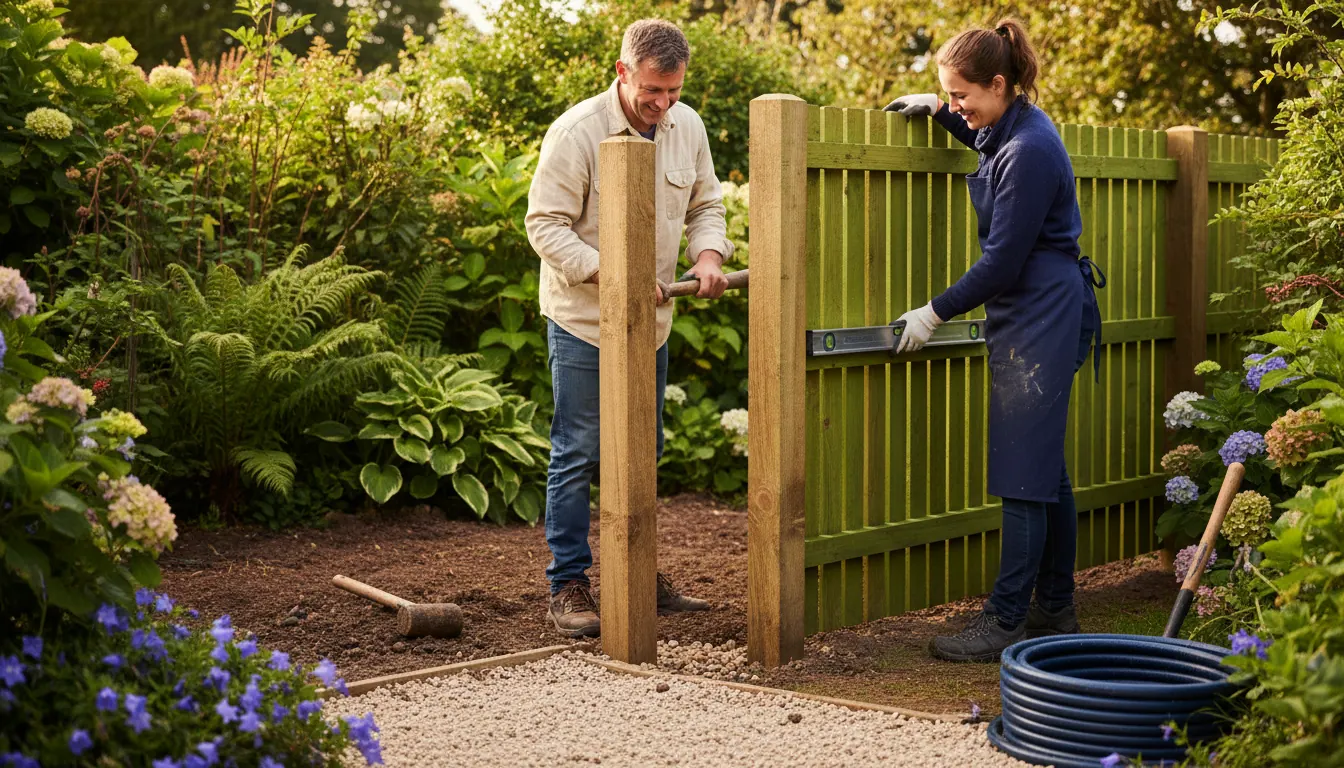
- Posts concreted to a minimum depth of 600mm, deeper on exposed or sloping ground
- Concrete packed firmly around the post base with no air pockets
- Posts checked for plumb before the concrete sets, not after
- Panels fitted only once the posts have had time to cure properly
- Gravel boards at the base where ground contact would otherwise rot the panel bottom
Gravel boards are worth a specific mention. Fitting a gravel board between the post and the ground means the timber panel never sits in soil or standing water. The gravel board takes the wear. When it eventually rots, you replace a gravel board, not the whole panel. That is a small detail that adds years to the life of the fence.
Timber fencing options for Huddersfield gardens
Most of our fencing work is in timber. It suits Yorkshire gardens, it looks right next to stone walls and brick, and it gives you flexibility on height, style and finish.
The options we fit most regularly:
Close board fencing. Overlapping vertical featherboard planks fixed to arris rails. Strong, solid, gives good privacy. Works well on boundary fences where you want something that will not flex in the wind.
Lap panel fencing. The standard horizontal panel. Cheaper to buy, quicker to fit, but less robust than close board. Fine for internal garden divisions or lower-traffic boundaries, though we would always recommend close board for any exposed or boundary position in West Yorkshire.
Trellis topper panels. Added above a solid fence to give extra height without the full weight and wind resistance of a solid panel. Useful where you want privacy but do not want to overload the posts.
Slatted or hit-and-miss fencing. Gaps between the boards reduce wind load and give a more contemporary look. Increasingly popular in garden redesigns where the fence is a design feature rather than just a boundary marker.
We do not do metal garden fencing. Our specialism is timber, fitted as part of a full garden project or as a standalone installation.
Fencing on sloping gardens
Huddersfield and Barnsley both have plenty of gardens that drop or rise sharply. Fencing a slope is not the same as fencing flat ground. You have two options: step the fence in sections, or rake it to follow the slope. Both have their place, and the right choice depends on the garden layout, the boundary line, and what you are trying to achieve.
Stepped fencing looks clean and defined. Each section is level, and the fence drops in steps to follow the ground. It suits formal layouts and works well alongside paving or structured planting.
Raked fencing follows the slope continuously. It looks more natural in an informal garden but requires more care in the post setting to make sure everything stays true.
On steeply sloping gardens, fencing often works alongside retaining walls. If you are terracing a garden, the boundary fence needs to work with the retaining structure, not against it. We plan both together when a project involves significant level changes. If you want to understand more about how we approach sloping ground, our article on how to fix a muddy, sloping garden in West Yorkshire covers the groundwork side in detail.
Fencing as part of a full garden transformation
A lot of our fencing work happens as part of a bigger project. A customer wants a new patio, turfing, raised beds and a replacement fence. We do all of it. The advantage is that everything is planned together: the fence line is set before the patio is laid, the gate position is agreed before the block paving goes in, and you are not trying to retrofit a boundary around a garden that has already been finished.
Doing it in the right order matters. If the fence is going in alongside new paving or landscaping, we set the posts first, let them cure, and then work the rest of the garden around them. That way nothing gets damaged and nothing has to be redone.
For garden design projects, fencing is often part of how a space gets defined. Dividing a garden into zones, screening a utility area, framing a patio. It is not just a boundary; it is part of the layout. We think about it the same way we think about levels and edges: as something that shapes how the garden feels and functions.
If you are considering a wider redesign alongside new fencing, our article on low-maintenance garden ideas for shaded and exposed Huddersfield gardens might give you some useful starting points.
Garden fencing costs in Huddersfield: what affects the price
We offer free quotes, so you will always get a clear figure before any work starts. But it helps to understand what drives the cost.
The main factors:
- Length of the run. More posts, more panels, more labour.
- Fence style. Close board costs more than lap panel. Slatted contemporary fencing costs more than close board. The material and the build time both affect the price.
- Ground conditions. Rocky ground, concrete from a previous fence, or steeply sloping terrain all add time to the post setting.
- Access. A garden that can only be reached through the house takes longer to work in than one with side access. Materials have to be carried further, and machinery cannot be used.
- Gate installation. A gate adds cost: the posts need to be set with particular precision, the hardware needs to be correct for the weight of the gate, and the whole thing needs to hang and close properly.
- Removal of the old fence. If there is an existing fence to take down and dispose of, that is additional labour and a skip or disposal run.
We do not give price ranges without seeing the job. Every garden in Huddersfield and Barnsley is different, and quoting blind does nobody any favours. Get in touch and we will come and look at it.
Frequently asked questions about garden fencing
How much does garden fencing cost in Huddersfield?
There is no single answer because the cost depends on the length of the run, the fence style, the ground conditions and whether old fencing needs removing. A short run of close board on flat, accessible ground costs less than a long boundary on a slope with difficult ground. We offer free quotes, so the best approach is to get us out to look at the job and give you a fixed figure. That way there are no surprises.
What is the 2 metre fence rule?
In England, you can build a fence up to 2 metres high without needing planning permission, as long as it is not adjacent to a highway used by vehicles. If the fence is next to a road, the limit drops to 1 metre. These are the rules for standard residential boundaries. If you are unsure about your specific situation, it is worth checking with Kirklees Council (for Huddersfield) or Barnsley Metropolitan Borough Council before the posts go in.
How deep should fence posts be set?
A commonly used guide is that the post should be in the ground for roughly one third of its total length. For a 1.8 metre fence using a 2.4 metre post, that means around 600mm in the ground. On exposed sites or where the fence is particularly tall, we go deeper. The post depth, combined with properly mixed and packed concrete, is what stops a fence leaning or blowing over.
Do I need to tell my neighbour before putting up a fence?
If the fence is on your land, within your boundary, you are not legally required to inform your neighbour before you put it up. That said, it is good practice to let them know, especially if the work will affect their access or light during installation. Where there is any uncertainty about where the boundary sits, it is worth checking your deeds before any posts go in. We are not solicitors and cannot advise on boundary disputes, but we will always work from a clear brief before we start.
Ready to get your fencing sorted?
We cover Huddersfield, Barnsley and the wider West and South Yorkshire area. Over 20 years of experience, a team that does not leave until the job is pin point perfect, and free quotes on every project.
Get in touch with us to arrange a free quote, or call us on 07359 173155.