Indian Sandstone Patio Installation in Huddersfield: What Proper Preparation Means
Thinking about an Indian sandstone patio in Huddersfield or across West Yorkshire? Here's what a quality installation really involves, from sub-base to finish.
Indian sandstone patio Huddersfield: the detail that decides whether it lasts
A new patio is one of the most visible things you can do to a garden. Get it right and it transforms the whole space. Get it wrong and within two or three winters you are looking at sunken slabs, puddles that sit for days, and joints that have crumbled out entirely.
We have been laying Indian sandstone patios across Huddersfield and the wider West and South Yorkshire area for over 20 years. What we have learned is simple: the stone itself is almost never the problem. It is everything underneath it.
This article explains what a proper Indian sandstone installation actually involves, so you know what to ask for and what to expect.
Why Indian sandstone is still the right choice for Yorkshire gardens
Indian sandstone has been the go-to paving material across West Yorkshire for good reason. It handles freeze-thaw cycles better than many alternatives, it weathers naturally rather than looking tired, and the range of colours, from warm buff and silver grey through to riven autumn brown, means it suits everything from a Victorian terrace in Huddersfield to a newer semi in Barnsley.
It is also honest material. The texture, the variation in tone, the slight imperfections in each slab: these are features, not faults. A well-laid Indian sandstone patio looks like it belongs in a Yorkshire garden. It does not look like a showroom floor.
That said, the quality of the stone itself does vary significantly. Look for calibrated Indian sandstone — calibrated means the slabs are cut to a consistent thickness, which matters enormously when you are bedding them level. Uncalibrated stone means constant packing and adjustment to keep the surface true, and where that adjustment is rushed you end up with lips between slabs that catch your feet and hold water.
Sub-base: the part nobody sees and everybody ignores until it fails
The single biggest factor in how long your patio lasts is what goes underneath it. A lot of patios in West Yorkshire were laid directly onto a sand bed, or onto a thin screed over compacted soil. They move. They sink. They crack.
A proper sub-base for an Indian sandstone patio works like this:
- Excavation to the correct depth, typically 150 to 200mm below finished patio level depending on the existing ground and what drainage is needed
- Hardcore (MOT Type 1) compacted in layers with a wacker plate, not just tipped and raked flat
- A sharp sand and cement bedding mortar mixed to the right consistency, laid at the correct depth to allow for the slab thickness
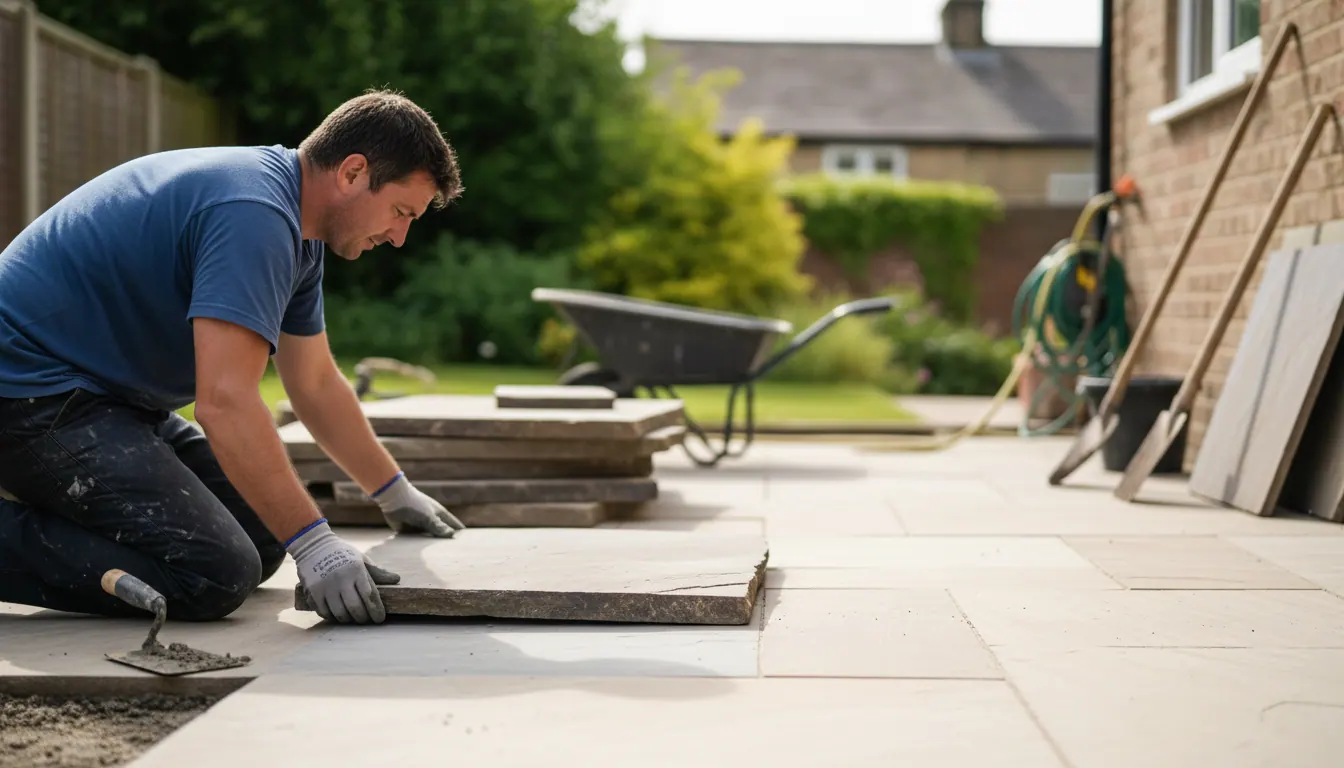
- Each slab set individually, checked for level and fall with a spirit level and straight edge, tapped down fully so there are no hollow spots underneath
That last point matters more than most people realise. A slab with a void underneath it will rock, crack, or sink the moment any weight is placed on it. Every slab we lay is fully bedded. No hollow spots, no shortcuts.
Falls and drainage: getting water off the patio and away from the house
Yorkshire gets a lot of rain. Any patio laid flat will hold water. That water either sits on the surface (which stains the stone and grows algae) or it finds its way into the sub-base (which undermines it over time).
Every patio we lay has a deliberate fall built into it. The standard is a fall of around 1 in 80 away from the house. That sounds small, but it is enough to move water consistently without the patio feeling like a slope underfoot.
Where we are working on a garden that already has drainage issues, we think about where that water is going to end up. Sometimes a channel drain at the patio edge is the right answer. Sometimes the fall directs water to a lawn or border where it can soak away. On harder clay-heavy plots, which are common across the Huddersfield area and into Barnsley, we may need to think about a soakaway or a connection to surface water drainage.
If your garden already has standing water or a boggy patch, it is worth reading our article on how to fix a muddy, sloping garden in West Yorkshire before you commit to any paving work. Laying a patio over a drainage problem does not solve the problem.
Pointing: the finish that holds everything together
Once the slabs are down and the mortar has cured, the joints need pointing. This is where a lot of patios fall apart, sometimes literally.
There are two main approaches: traditional wet mortar pointing and brush-in resin-based grout (sometimes called polymeric jointing compound). We use both, depending on the job and the client's preference.
Traditional mortar pointing, done correctly, is durable and looks right with Indian sandstone. The key word is correctly: the mortar needs to be the right mix, pressed firmly into the joint, finished neatly, and not smeared across the face of the stone. Smearing mortar across Indian sandstone and then wiping it off leaves a haze that is very difficult to remove.
Resin-based jointing compounds are more flexible, which means they handle ground movement better, and they resist weed growth more effectively. On a patio that is going to see heavy use, or on a plot where tree roots or soil movement is a factor, we often recommend this approach.
Either way, the joints should be consistent in depth, full, and finished flush or slightly recessed. Proud joints collect water. Empty joints let weeds in.
Edges and borders: where patios meet the rest of the garden
The edge of a patio is where the job either looks finished or it does not. Sloppy edges, slabs that overhang awkwardly, gaps where the patio meets the lawn or a raised border: these things stand out.
We cut every edge slab to fit. No approximate trimming, no leaving a gap and filling it with gravel. If the patio meets a lawn, we set the finished patio level slightly below the turf so a mower can run along the edge cleanly. If it meets a raised bed or a wall, we detail that junction properly.
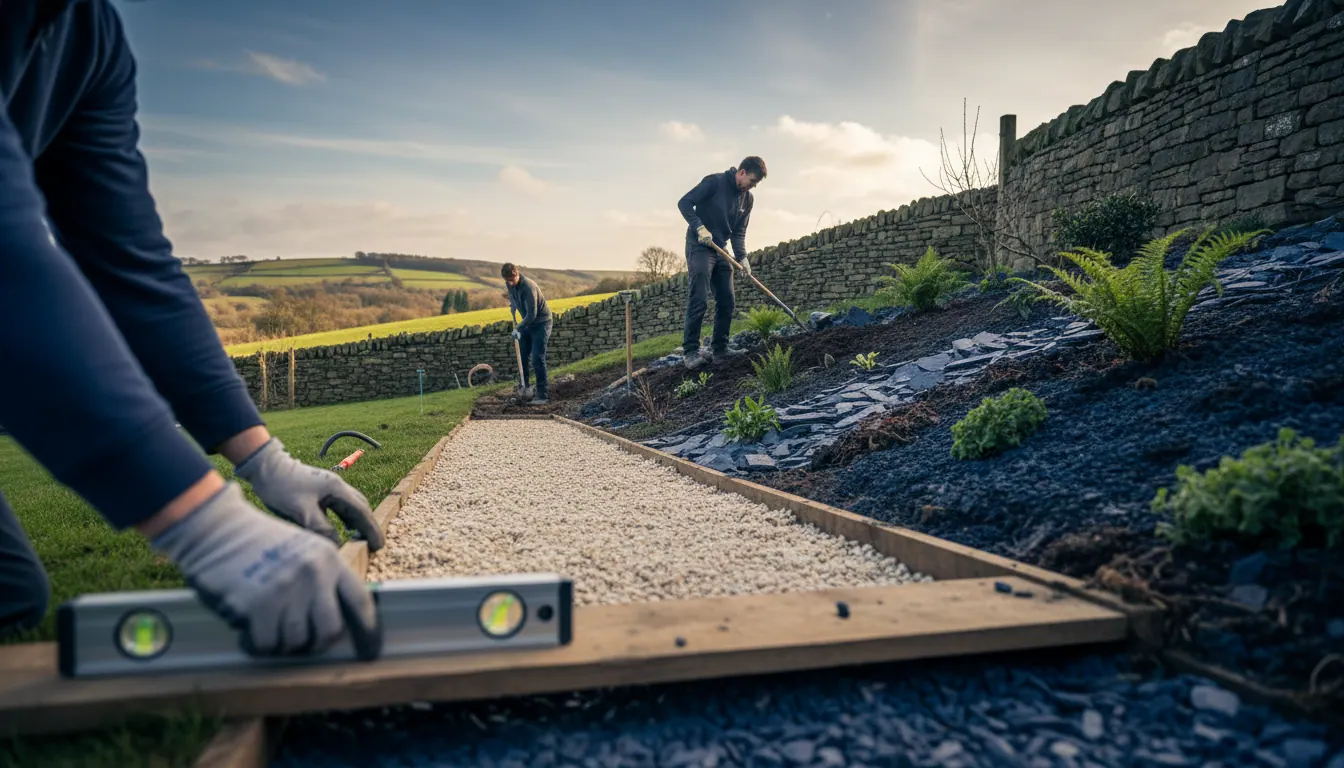
On a lot of the stone-built properties around Huddersfield, the patio has to work around existing walls, steps, or changes in level. That is where the groundwork experience matters. Laying a flat patio on a flat garden is straightforward. Laying one that ties into a retaining wall, steps, and an awkward slope, and making it all look intentional, that is a different job.
How long does a patio take?
A standard back garden patio in Huddersfield or Barnsley, say 30 to 40 square metres, typically takes us two to three days. That includes excavation, sub-base, laying, and initial pointing.
Costs vary depending on the size, the stone grade you choose, access to the garden, and the complexity of the groundwork. We do not quote a price per square metre on a website because every garden is different. What we do offer is a free quote, with no obligation. We come out, look at the space, talk through what you want, and give you a straight price.
If you are thinking about booking for spring, now is a good time to get in touch. Our diary fills up from late winter onwards, and the best slots go early.
Frequently asked questions
How long will an Indian sandstone patio last in West Yorkshire?
Laid correctly, on a proper compacted sub-base with good drainage and sound pointing, Indian sandstone will last 20 to 30 years without major issues. The stone itself is very durable. Problems almost always come from inadequate sub-base preparation, poor drainage, or joints that were never properly filled and have let water and weeds in over the years.
Does Indian sandstone need sealing?
It does not have to be sealed, but sealing does help. A good quality impregnating sealer reduces staining, slows algae growth, and makes the stone easier to clean. We can advise on this when we quote, and we can apply a sealer as part of the job if you want it done properly from day one.
Can you lay a patio on a sloping garden in Huddersfield?
Yes, and we do it regularly. The approach depends on the degree of slope. A gentle slope can be accommodated by stepping the patio or by building it up at the lower end with additional sub-base. A steeper slope may need a retaining wall to create a level area. Either way, the drainage has to be thought through carefully, because water follows the original slope and needs somewhere to go.
How do I get a quote for a patio in Huddersfield or Barnsley?
Call or WhatsApp us on 07359 173155, or drop us an email at curtpaul2687@gmail.com. Quotes are free and there is no obligation. We cover Huddersfield, Barnsley, and the surrounding areas across West and South Yorkshire.
Ready to talk about your garden?
If you are thinking about an Indian sandstone patio in Huddersfield or anywhere across West or South Yorkshire, we are happy to come out and take a look. No sales pitch, no pressure. Just a straight conversation about what you want and what it will take to do it properly.
Get in touch with us and we will arrange a free quote at a time that suits you.